Showing posts with label Habitat. Show all posts

Monday, September 14, 2015

Royal Belum, Perak

My first visit to Royal Belum was in 2007. Time really flies, and that I revisited to Royal Belum a couple of days ago for an Odonata inventory. In a short 4-day of inventory, I recorded 43 species, and the most interesting find was Coeliccia kimurai.....


Kooi Waterfall


Temengor Lake


Friday, April 24, 2015

An Odonata Holiday in Taman Negara Pahang

The last time I had my Odonata holiday in Taman Negara (Kuala Koh, Kelantan) was in April 2005. Time flies, and it has been more than 10 years for me to have my second Odonata holiday in Taman Negara (Pahang). I must thank Jabatan PERHILITAN for the cordial invitation. This time we entered Taman Negara from Kuala Tahan, Pahang. From Kuala Tahan to Kuala Kelapor (the camp site), we could still observe everywhere the scars and wounds from the destructive big flood which happened in the late December 2014.

We started our journey at Kuala Tahan in the early morning on 14 April 2015. We were on 4-wheel drives for 3 hours before arriving at a drop off point at Kuala Sat. Then, we took long boats on Sg Sat heading to Kuala Kelapor. The whole boat journey was only roughly 1 hour, but we had to get off boats at a few spots of low water level to push the boats.


The team is getting ready to set off to the camp site in Taman Negara


Finally we arrived safely at the camp site at Kuala Kelapor in the early afternoon without much trouble. The camp site was located by Sg Sat. Therefore, our water supply (drinking, bathing, and even our toilet) was from Sg Sat. One thing I enjoyed much was to soak myself in the water of Sg Sat in the hot afternoon.


the camp site at Kuala Kelapor


Sg Sat - our main source of water supply


Sg Kelapor is a sluggish and slow flowing stream, and it is good for many Odonata species


It was flowering season for a few plant species during our visit there, particularly Saraca thaipingensis. The presence of the flowers definitely made the forest looking good.


Gardenia carinata


Saraca thaipingensis


One of the unexpected things that I encountered during the stay at Kuala Kelapor was the witness of the delivery of a new born baby bat (Kerivoula papilosa). It was so sweet to see the whole process of delivery.


A female bat (Kerivoula papilaso) just delivered a baby bat


My Odonata holiday went well, and I managed to record at least 50 species of Odonata during my stay at Kuala Kelapor. We departed from Kuala Kelapor on 22 April 2015........
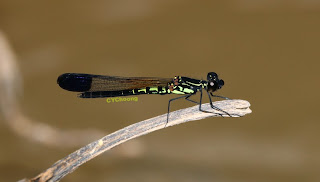

Libellago semiopaca (male)


Archibasis rebeccae (male)


Onychothemis testacea (male)


Lathrecista asiatica (male)


Rhinagrion viridatum (female)


Rhinagrion microcephalum (egg-laying female)


Saturday, June 15, 2013

A Site for Dragonfly Watching

The site shown in the below photograph is an excellent site for dragonfly watching. At least 27 Odonata species can be spotted at this site. The Odonata species are:

Acisoma panorpoides
Aethriamanta gracilis
Agriocnemis nana
Brachydiplax chalybea
Brachythemis contaminata
Ceriagrion cerinorubellum
Crocothemis servilia
Diplacodes nebulosa
Epophthalmia vittigera
Hydrobasileus croceus
Ictinogomphus decoratus
Indothemis limbata
Lestes praemorsus
Nannophya pygmaea
Neurothemis fluctuans
Orthetrum chrysis
Orthetrum sabina
Pseudagrion australasiae
Pseudagrion microcephalum
Pseudothemis jorina
Rhodothemis rufa
Rhyothemis phyllis
Rhyothemis triangularis
Tramea transmarina
Trithemis aurora
Trithemis festiva
Urothemis signata


If you fancy a dragonfly watching at this site, do kindly contact me.


Sunday, June 2, 2013

Sungai Belait, Brunei

I felt so calm looking over the abandoned village of Kuala Balai by the Sungai Belait...


Wednesday, May 29, 2013

A Small Waterfall in Brunei

I visited to this small waterfall in Brunei for Odonata...


Tuesday, March 5, 2013

Sungai Belait, Brunei

Sungai Belait is the largest river of Brunei. The river and its surrounding areas are refuge for many interesting damselflies and dragonflies.


Sunday, December 30, 2012

Tropical Rain Forest

What a beautiful tropical rain forest of Malaysia....


Thursday, September 1, 2011

Waterfalls

I visited to a few waterfalls in Terengganu last month. These waterfalls are just beautiful.


Sekayu Waterfall


Lasir Waterfall


Bukit Kesing Waterfall


Monday, May 9, 2011

Seremban Lake Garden

I arrived at Klana Resort Hotel, Seremban this late afternoon to attend a seminar. I saw a small lake (Seremban Lake Garden; shown in the photos below) not too far from the hotel. After checking in the hotel, I went to the lake to do Odonata observation for two hours (5-7 pm). The weather was good, and I went around the lake looking for Odonata. I spotted ten species of Odonata. Brachythemis contaminata and Pseudagrion microcephalum were present in abundant at the lake in late afternoon.


PS:
I visited again Seremban Lake Garden in the morning two day later. I stayed there for roughly two hours (10am - 12pm). I spotted another 11 species. These additional species have been added to the checklist. Now, the checklist contains 21 species altogether.

Odonata species recorded at Seremban Lake Garden:

Agriocnemis femina (Brauer, 1868)
Ischnura senegalensis (Rambur, 1842)
Ceriagrion chaoi Schmidt, 1964
Pseudagrion microcephalum (Rambur, 1842)
Pseudagroin rubriceps Selys, 1876
Ictinogomphus decoratus melaenops (Selys, 1858)
Acisoma panorpoides Rambur, 1842
Aethriamanta brevipennis (Rambur, 1842)
Aethriamanta gracilis (Brauer, 1878)
Brachydiplax chalybea Brauer, 1868
Brachydiplax farinosa Krüger, 1902
Brachythemis contaminata (Fabricius, 1793)
Crocothemis servilia (Drury, 1770)
Neurothemis fluctuans (Fabricius, 1793)
Orthetrum chrysis (Selys, 1891)
Orthetrum sabina (Drury, 1770)
Pseudothemis jorina Förster, 1904
Rhyothemis phyllis (Sulzer, 1776)
Tholymis tillarga (Fabricius, 1798)
Trithemis aurora (Burmeister, 1839)
Urothemis signata insignata (Selys, 1872)


Sunday, April 24, 2011

Bangi Forest Reserve

Bangi Forest Reserve has a small unnamed river. It is a very nice river for many common Odonata species.


Monday, December 6, 2010

Imbak Canyon - A Haven on Earth

I'm back from Imbak Canyon (Sabah)!

Full of excitement, full of adventures, full of joy, full of everything...... Imbak Canyon is truely a haven on earth.

Over 30 species of Odonata have been recorded within 10 days of field work in Imbak Canyon. I managed to snap good shots on few of these species, and I shall share with you in the next few blog entries......


the misty morning of Kangkawat River


another view of misty morning of Kangkawat River


the magnificent Kuli Waterfall


Crossing Imbak River to get into Imbak Canyon Conservation Area


Sunday, November 7, 2010

Sg Tekala Recreational Forest

Sg Tekala Recreational Forest, Selangor is not far from the place I live - 25 km to be exact. I passed by the recreational forest a few times only, but I never got off my car to pay a visit to the recreational forest. Nevertheless, I've finally paid a visit to the recreational forest over the weekend. To my surprise, I was really impressed by the beauty and peace of the recreational forest. The recreational forest is built along Sg Tekala. It could be very busy during weekends. Visitors (mainly families) tend to gether not far from the entrance of the recreational forest for having a nice day-out. For those who fancy peace, however, may have to get deep into the recreational forest.


Sg Tekala

Sg Tekala

Small waterfall at the upstream of Sg Tekala


Tuesday, July 13, 2010

Odonata Checklist of Sg Durian, Perak

I visited Sg Durian, Lintang, Perak for second time a few days ago to survey the odonate diversity. I managed to add six more species to the previous checklist. Now the total number of odonate species recorded for Sg Durian is 30.


Odonata Checklist for Sg Durian, Lintang, Perak

Family Calopterygidae
Neurobasis chinensis
Vestalis amoena


Family Chlorocyphidae
Heliocypha perforata
Heliocypha biforata
Libellago lineata


Family Euphaeidae
Dysphaea dimidiata
Euphaea impar
Euphaea ochracea


Family Megapodagrionidae
Rhinagrion mima

Family Coenagrionidae
Agriocnemis femina
Argiocnemis rubescens
Onychargia atrocyana
Mortonagrion aborense
Pseudagrion pruinosum


Family Platycnemididae
Copera ciliata
Copera marginipes


Family Protoneuridae
Prodasineura humeralis
Prodasineura collaris


Family Gomphidae
Ictinogomphus decoratus
Paragomphus capricornis


Family Libellulidae
Aethriamanta gracilis
Brachydiplax chalybea
Neurothemis fluctuans
Onychothemis culminicola
Orthetrum chrysis
Orthetrum luzonicum
Orthetrum testaceum
Trithemis aurora
Trithemis festiva
Zygonyx iris


Monday, May 24, 2010

Sg Durian, Lintang, Perak

I was back to my home town in Perak to see my folk over the weekend. Of course, I did not forget to spend a day searching for odonates somewhere near my home town. I went to Sg Durian in Lintang, Perak to observe and take pictures of odonates. For four hours of hanging around Sg Durian, I spotted 24 species of odonates. Sg Durian is located 3 km away from Lintang small town. The water of the river is clear and the river flows through oil palm and rubber plantations.


Odonata Checklist for Sg Durian, Lintang, Perak

Family Calopterygidae
Vestalis amoena

Family Chlorocyphidae
Heliocypha perforata
Heliocypha biforata
Libellago lineata


Family Euphaeidae
Euphaea impar
Euphaea ochracea


Family Megapodagrionidae
Rhinagrion mima

Family Coenagrionidae
Agriocnemis femina
Mortonagrion aborense
Pseudagrion pruinosum


Family Platycnemididae
Copera ciliata
Copera marginipes


Family Protoneuridae
Prodasineura humeralis
Prodasineura collaris


Family Gomphidae
Ictinogomphus decoratus
Paragomphus capricornis


Family Libellulidae
Aethriamanta gracilis
Neurothemis fluctuans
Onychothemis culminicola
Orthetrum chrysis
Orthetrum testaceum
Trithemis aurora
Trithemis festiva
Zygonyx iris


Thursday, May 6, 2010

Kenaboi Forest Reserve, Negeri Sembilan

Kenaboi Forest Reserve is located in Jelebu District of Negeri Sembilan. The highest point of the Kenaboi Forest Reserve is Gunung Besar Hantu. I joined the scientific expedition to Gunung Besar Hantu organised by Jabatan Perhutanan Semenanjung Malaysia and Jabatan Perhutanan Negeri Sembilan. However, I did not climb up to Gunung Besar Hantu (1480 m). We stayed at the forest reserve for four nights. We drank the water from Semong River and bathed using the water from Kenaboi River. The water from the rivers is so crystal clear. I really enjoyed the expedition. One of the highlights of the Kenaboi Forest Reserve is the Lata Kijang (Kijang Waterfall). The waterfall is so high, and I was amazed by the beauty of the waterfall.

Of course, my main intention to Kenaboi Forest Reserve was to record the odonate diversity. Within the very short four days of field work at various locations of Kenaboi Forest Reserve, I managed to record 40 species including some rare ones - Onychogomphus castor, Onychogomphus thienemanni and Nepogomphus walli. There were plenty of Neurobasis chinensis, Heliocypha perforata, Euphaea ochracea and Vestalis amoena at Semong and Kenaboi Rivers.


Semong River

Kenaboi River

Kenaboi River

a tributary of Semong River

Kijang Waterfall


Sunday, April 4, 2010

Larva of Podolestes orientalis

The paper of the description of Podolestes orientalis larva has finally been out. Please let me know if you need the soft copy of the paper.

Choong, C.Y. and Orr, A.G. 2010. The larva of Podolestes orientalis from West Malaysia, with notes on its habitat and biology (Odonata: Megapogrionidae). International Journal of Odonatology 13(1): 109-117.

The abstract of the above article is as below:
The larva of the south-east Asian megapodagrionid, Podolestes orientalis, is described and figured. Specimens were collected from shallow forest pools lined with large dead leaves in secondary lowland forest. Final and earlier stadium larvae were found concentrated around the edges of pools in very shallow water. Larvae sometimes perched in exposed situations, just below the water surface, with abdomen upturned and caudal lamellae splayed outward to expose the broad respiratory surfaces. This represents the first account of the immature stages for this south-east Asian genus. The caudal lamellae are very broad and flattened, inserted horizontally, suggesting a close relationship between the genus Podolestes and Australian region megapodagrionids.


So, how does the larva of P. orientalis look like? Here you go......


Below are two photos taken in situ at the natural habitat of P. orientalis larva.


So, how does the natural aquatic habitat look like for the larva of P. orientalis? The below photo shows the aquatic habitat from where I found the larvae of P. orientalis. The larvae concentrated at the shallow water edge covered with fallen leaves and sticks......