
Showing posts with label Libellulidae. Show all posts
Showing posts with label Libellulidae. Show all posts
Tuesday, June 14, 2016
Tuesday, May 3, 2016

Friday, January 8, 2016

Tuesday, July 28, 2015
Tholymis tillarga
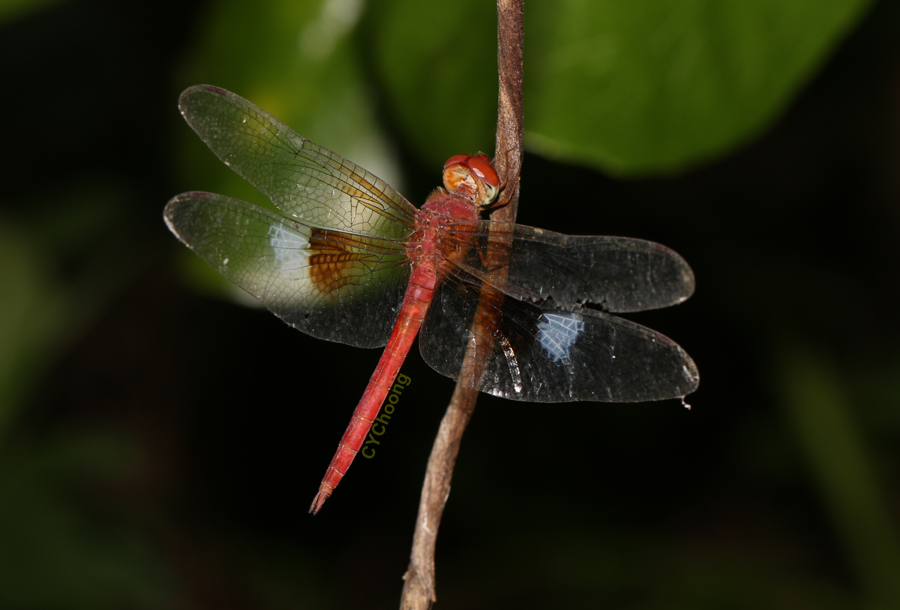
One of the libellulid species that I am always attracted to is Tholymis tillarga. The hindwings of T. tillarga have white patch. It is definitely not easy to bring out the white patch of the hindwings in photos....


Friday, April 24, 2015
An Odonata Holiday in Taman Negara Pahang
The last time I had my Odonata holiday in Taman Negara (Kuala Koh, Kelantan) was in April 2005. Time flies, and it has been more than 10 years for me to have my second Odonata holiday in Taman Negara (Pahang). I must thank Jabatan PERHILITAN for the cordial invitation. This time we entered Taman Negara from Kuala Tahan, Pahang. From Kuala Tahan to Kuala Kelapor (the camp site), we could still observe everywhere the scars and wounds from the destructive big flood which happened in the late December 2014.
We started our journey at Kuala Tahan in the early morning on 14 April 2015. We were on 4-wheel drives for 3 hours before arriving at a drop off point at Kuala Sat. Then, we took long boats on Sg Sat heading to Kuala Kelapor. The whole boat journey was only roughly 1 hour, but we had to get off boats at a few spots of low water level to push the boats.

The team is getting ready to set off to the camp site in Taman Negara
Finally we arrived safely at the camp site at Kuala Kelapor in the early afternoon without much trouble. The camp site was located by Sg Sat. Therefore, our water supply (drinking, bathing, and even our toilet) was from Sg Sat. One thing I enjoyed much was to soak myself in the water of Sg Sat in the hot afternoon.

the camp site at Kuala Kelapor

Sg Sat - our main source of water supply

Sg Kelapor is a sluggish and slow flowing stream, and it is good for many Odonata species
It was flowering season for a few plant species during our visit there, particularly Saraca thaipingensis. The presence of the flowers definitely made the forest looking good.

Gardenia carinata

Saraca thaipingensis
One of the unexpected things that I encountered during the stay at Kuala Kelapor was the witness of the delivery of a new born baby bat (Kerivoula papilosa). It was so sweet to see the whole process of delivery.

A female bat (Kerivoula papilaso) just delivered a baby bat
My Odonata holiday went well, and I managed to record at least 50 species of Odonata during my stay at Kuala Kelapor. We departed from Kuala Kelapor on 22 April 2015........
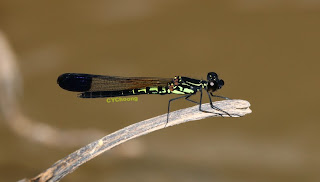
Libellago semiopaca (male)

Archibasis rebeccae (male)

Onychothemis testacea (male)

Lathrecista asiatica (male)

Rhinagrion viridatum (female)

Rhinagrion microcephalum (egg-laying female)
We started our journey at Kuala Tahan in the early morning on 14 April 2015. We were on 4-wheel drives for 3 hours before arriving at a drop off point at Kuala Sat. Then, we took long boats on Sg Sat heading to Kuala Kelapor. The whole boat journey was only roughly 1 hour, but we had to get off boats at a few spots of low water level to push the boats.

The team is getting ready to set off to the camp site in Taman Negara
Finally we arrived safely at the camp site at Kuala Kelapor in the early afternoon without much trouble. The camp site was located by Sg Sat. Therefore, our water supply (drinking, bathing, and even our toilet) was from Sg Sat. One thing I enjoyed much was to soak myself in the water of Sg Sat in the hot afternoon.

the camp site at Kuala Kelapor

Sg Sat - our main source of water supply

Sg Kelapor is a sluggish and slow flowing stream, and it is good for many Odonata species
It was flowering season for a few plant species during our visit there, particularly Saraca thaipingensis. The presence of the flowers definitely made the forest looking good.

Gardenia carinata

Saraca thaipingensis
One of the unexpected things that I encountered during the stay at Kuala Kelapor was the witness of the delivery of a new born baby bat (Kerivoula papilosa). It was so sweet to see the whole process of delivery.

A female bat (Kerivoula papilaso) just delivered a baby bat
My Odonata holiday went well, and I managed to record at least 50 species of Odonata during my stay at Kuala Kelapor. We departed from Kuala Kelapor on 22 April 2015........

Libellago semiopaca (male)

Archibasis rebeccae (male)

Onychothemis testacea (male)

Lathrecista asiatica (male)

Rhinagrion viridatum (female)

Rhinagrion microcephalum (egg-laying female)
Wednesday, September 3, 2014

Friday, August 22, 2014

Monday, March 31, 2014


Wednesday, August 28, 2013

Sunday, July 28, 2013

Tuesday, July 2, 2013

Monday, July 1, 2013

Monday, June 10, 2013
Tramea transmarina vs Tramea phaeoneura
Tramea transmarina can be found in Peninsular Malaysia and Borneo while T. phaeoneura is confined to Borneo. Even in Borneo, T. phaeoneura is much less common compared to T. transmarina. Both the species are hard to be identified when they are high in flight. One may use the extensiveness of dark patch of hind wings to tell them apart - T. transmarina has more extensive dark patch of hind wings compared to T. phaeoneura. However, this character is sometime variable. The best way to verify these two species is to look into their anal appendages and genitalia.


Friday, May 31, 2013

Monday, March 25, 2013

Saturday, March 23, 2013
A Swarm of Rhyothemis Species
I saw a swarm of Rhyothemis species at the top of forest tree canopy. I am not sure if the Rhyothemis was R. atterima, R. obsolescens or R. pygmaea (fulgens) as it was too far for me to make good judgement. The broad wings of the dragonflies looked black in colour from far. These three Rhyothemis species were present at the forest area.


Friday, March 22, 2013


Sunday, March 17, 2013

Wednesday, March 13, 2013

Subscribe to:
Posts (Atom)