
Showing posts with label Chlorocyphidae. Show all posts
Showing posts with label Chlorocyphidae. Show all posts
Tuesday, May 3, 2016
Friday, April 24, 2015
An Odonata Holiday in Taman Negara Pahang
The last time I had my Odonata holiday in Taman Negara (Kuala Koh, Kelantan) was in April 2005. Time flies, and it has been more than 10 years for me to have my second Odonata holiday in Taman Negara (Pahang). I must thank Jabatan PERHILITAN for the cordial invitation. This time we entered Taman Negara from Kuala Tahan, Pahang. From Kuala Tahan to Kuala Kelapor (the camp site), we could still observe everywhere the scars and wounds from the destructive big flood which happened in the late December 2014.
We started our journey at Kuala Tahan in the early morning on 14 April 2015. We were on 4-wheel drives for 3 hours before arriving at a drop off point at Kuala Sat. Then, we took long boats on Sg Sat heading to Kuala Kelapor. The whole boat journey was only roughly 1 hour, but we had to get off boats at a few spots of low water level to push the boats.

The team is getting ready to set off to the camp site in Taman Negara
Finally we arrived safely at the camp site at Kuala Kelapor in the early afternoon without much trouble. The camp site was located by Sg Sat. Therefore, our water supply (drinking, bathing, and even our toilet) was from Sg Sat. One thing I enjoyed much was to soak myself in the water of Sg Sat in the hot afternoon.

the camp site at Kuala Kelapor

Sg Sat - our main source of water supply

Sg Kelapor is a sluggish and slow flowing stream, and it is good for many Odonata species
It was flowering season for a few plant species during our visit there, particularly Saraca thaipingensis. The presence of the flowers definitely made the forest looking good.

Gardenia carinata

Saraca thaipingensis
One of the unexpected things that I encountered during the stay at Kuala Kelapor was the witness of the delivery of a new born baby bat (Kerivoula papilosa). It was so sweet to see the whole process of delivery.

A female bat (Kerivoula papilaso) just delivered a baby bat
My Odonata holiday went well, and I managed to record at least 50 species of Odonata during my stay at Kuala Kelapor. We departed from Kuala Kelapor on 22 April 2015........
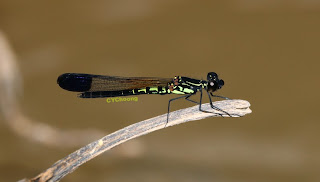
Libellago semiopaca (male)

Archibasis rebeccae (male)

Onychothemis testacea (male)

Lathrecista asiatica (male)

Rhinagrion viridatum (female)

Rhinagrion microcephalum (egg-laying female)
We started our journey at Kuala Tahan in the early morning on 14 April 2015. We were on 4-wheel drives for 3 hours before arriving at a drop off point at Kuala Sat. Then, we took long boats on Sg Sat heading to Kuala Kelapor. The whole boat journey was only roughly 1 hour, but we had to get off boats at a few spots of low water level to push the boats.

The team is getting ready to set off to the camp site in Taman Negara
Finally we arrived safely at the camp site at Kuala Kelapor in the early afternoon without much trouble. The camp site was located by Sg Sat. Therefore, our water supply (drinking, bathing, and even our toilet) was from Sg Sat. One thing I enjoyed much was to soak myself in the water of Sg Sat in the hot afternoon.

the camp site at Kuala Kelapor

Sg Sat - our main source of water supply

Sg Kelapor is a sluggish and slow flowing stream, and it is good for many Odonata species
It was flowering season for a few plant species during our visit there, particularly Saraca thaipingensis. The presence of the flowers definitely made the forest looking good.

Gardenia carinata

Saraca thaipingensis
One of the unexpected things that I encountered during the stay at Kuala Kelapor was the witness of the delivery of a new born baby bat (Kerivoula papilosa). It was so sweet to see the whole process of delivery.

A female bat (Kerivoula papilaso) just delivered a baby bat
My Odonata holiday went well, and I managed to record at least 50 species of Odonata during my stay at Kuala Kelapor. We departed from Kuala Kelapor on 22 April 2015........

Libellago semiopaca (male)

Archibasis rebeccae (male)

Onychothemis testacea (male)

Lathrecista asiatica (male)

Rhinagrion viridatum (female)

Rhinagrion microcephalum (egg-laying female)

Tuesday, September 3, 2013

Thursday, August 29, 2013

Wednesday, August 28, 2013

Monday, September 24, 2012

Saturday, July 14, 2012


Wednesday, August 31, 2011
Libellago aurantiaca
From far, Libellago aurantiaca looks alike Sundacypha petiolata. However, a close look reveals that the thoracic yellow marking and dark patch on hindwings are different between these two species.


Sunday, June 26, 2011

Wednesday, December 15, 2010
Libellago stigmatizans
Libellago stigmatizans is a beutiful damselfly species with a bit of orange colour on the head. It is normally found at rocky forest streams.


Tuesday, December 7, 2010
Rhinocypha humeralis
Rhinocypha humeralis is found abundantly in Imbak Canyon (Borneo Sabah). The blue marking on the side of its abdomen is just beautiful. The female of R. humeralis is rather dull in colour, but the wing tips is dark.

a male Rhinocypha humeralis

a female Rhinocypha humeralis


Sunday, October 17, 2010
Libellago lineata in Wheel
I see Libellago lineata regularly in Bangi Forest Reserve with male and female in equal number. However, these L. lineata individuals are not horny - hardly see them in copulation. My latest visit to Bangi Forest Reserve was rewarding as I spotted a wheel pair of L. lineata, and of course I took some shots on this wheel pair.


Tuesday, August 31, 2010

Sunday, August 22, 2010
Libellago lineata - Female
Showing below are photos of female Libellago lineata. Click here to view the photos of male L. lineata.


Monday, May 24, 2010
Heliocypha biforata - Male and Female
I've finally taken some nice pictures of female Heliocypha biforata. The female of H. biforata does look slightly different from the females of H. perforata and Aristocypha fenestrella.

a male Heliocypha biforata

a female Heliocypha biforata

an ovipositing female Heliocypha biforata


Friday, May 7, 2010
Heliocypha perforata - Male and Female
The Semong and Kenaboi Rivers in Kenaboi Forest Reserve are rich of Heliocypha perforata. Taking good photos of them was not too difficult.

a male of H. perforata

an ovipositing female of H. perforata


Aristocypha fenestrella - Male and Female
I found some Aristocypha fenestrella at a tributary of Semong River in Kenaboi Forest Reserve. Only A. fenestrella not other species of Chlorocyphidae was spotted at the tributary. I spotted both the male and female of A. fenetrella, and I took a few good shots on them.

a male of A. fenestrella

a female of A. fenestrella


Thursday, October 1, 2009
Chlorocyphidae - Libellago hyalina
Libellago hyalina is normally found at sluggish streams and swamp forest. The matured male has violet colour on its abdomen. There are plenty of them in Sg Bebar. Therefore, I had good opportunity to take some nice shoots of them during my visit to Sg Bebar.

a matured male Libellago hyalina

a female Libellago hyalina


Sunday, August 16, 2009
Chlorocyphidae - Heliocypha biforata
Heliocypha biforata is a beautiful damselfly species. It looks alike H. perforata, yet both the species could be distinguished easily. H. biforata has more intensive pink marking on its dorsal thorax and less obvious blue marking on its abdomen compared to H. perforata. H. biforata and H. perforata share similar habitat (fast flowing forest stream) and have similar behaviour (pearching on logs and rock along the stream).


Subscribe to:
Posts (Atom)