
Showing posts with label Aeshnidae. Show all posts
Showing posts with label Aeshnidae. Show all posts
Tuesday, September 22, 2015
Tuesday, August 18, 2015

Thursday, February 19, 2015

Friday, August 22, 2014

Monday, December 9, 2013

Friday, August 30, 2013

Thursday, December 27, 2012
Cephalaeschna laidlawi
Cephalaeschna laidlawi or some other workers calling it as Periaschna laidlawi is a rare montane dragonfly species in Peninsular Malaysia. Before my encounter on this species, only a few specimens have been collected by other workers (Forster 1908; Laidlaw 1931; Kawashima and Sasamoto 2006). Forster (1908) and Laidlaw (1931) collected one male and two female adults. On the other hand, Kawashima and Sasamoto (2006) collected three larvae (two males and one female - all successfully bred to emergence).
My first time to encounter this species was in 2007 - a few larvae were collected from a forest stream and successfully bred to emergence. My second time to encounter it was in 2011 - a few beautiful male adults were collected in the wild. It means that I am the second person to encounter male adult (not from emergence) in the wild after Forster (1908). How lucky I was.....
I supposed many might not have seen the real full colour of this species (newly emerged adult might not have yet to develop full colour). Here you go....

My first time to encounter this species was in 2007 - a few larvae were collected from a forest stream and successfully bred to emergence. My second time to encounter it was in 2011 - a few beautiful male adults were collected in the wild. It means that I am the second person to encounter male adult (not from emergence) in the wild after Forster (1908). How lucky I was.....
I supposed many might not have seen the real full colour of this species (newly emerged adult might not have yet to develop full colour). Here you go....


Sunday, June 17, 2012

Sunday, June 3, 2012

Saturday, June 2, 2012

Sunday, May 20, 2012

Sunday, April 29, 2012
Anax Larva
A larva of Anax guttatus or Anax panybeus........

P/S: It has emerged. It is a female of Anax panybeus.

P/S: It has emerged. It is a female of Anax panybeus.
Wednesday, March 28, 2012
Gynacantha basiguttata
Gynacantha basiguttata is one of the common aeshnid species in Peninsular Malaysia.


Sunday, May 29, 2011


Thursday, August 19, 2010
Gynacantha subinterrupta - Female
I knew that one Gynacantha subinterrupta female larva wanted to emerge in an very early morning. I waited until 2 o'clock morning for the larva to emerge, and I was so tried that I decided to go to bed....

a female larva of Gynacantha subinterrupta is out of water and clinging high away from water. It emerged three hours later.

the young adult of female Gynacantha subinterrupta - 15 hours after the larval emergence

the young adult of female Gynacantha subinterrupta - 15 hours after the larval emergence


Friday, August 6, 2010


Wednesday, August 4, 2010
Larval Emergence - Anax panybeus (Male)
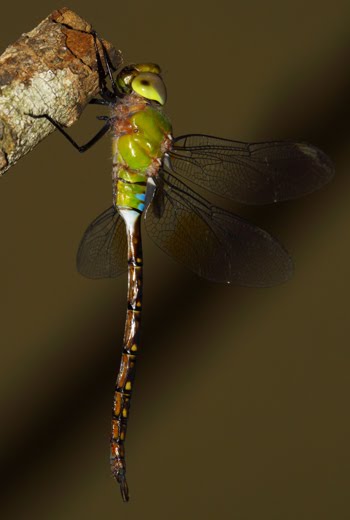
In order to record the larval emergence of Anax panybeus I had a sleepless night. The A. panybeus larva broke its larval casing around 2.30 am and had its wings fully open arond 4.30 am. I was really impressed by the emerald green colour on the thorax of the emerging adult as the colour was so bright and intensed.

This male larva image (F0 stage) was taken some time ago. Ten days later, the larva went through metamorphosis and turned into a beautiful Anax panybeus male adult.


Monday, July 26, 2010
Anax guttatus vs Anax panybeus - Anal Appendages
Anax guttatus and A. panybeus are quite similar to each other. In fact when I caught a specimen of A. guttatus a few years back, I labelled it as A. guttatus. My mistake was immediately pointed out by Dr. A.G. Orr when he inspected my specimen during his visit to Malaysia.
One important character to distinguish A. guttatus from A. panybeus is their anal appendages. The anal appendages of A. panybeus is more massive and larger than that of A. guttatus. Of course, the shape of anal appendages for both the species is also slightly different.

left is A. guttatus and right is A. panybeus
One important character to distinguish A. guttatus from A. panybeus is their anal appendages. The anal appendages of A. panybeus is more massive and larger than that of A. guttatus. Of course, the shape of anal appendages for both the species is also slightly different.

Thursday, July 22, 2010
Comparison: Anax guttatus vs Anax panybeus
Two Anax species are recorded in Peninsular Malaysia - Anax guttatus and A. panybeus. The anal appendages and the length of abdominal segment 3 are the main characters to differentiate these two species. However, I am showing you here the differences of blue marking on the thorax and dorsal abdominal segments 1-3 for both the species.

left: Anax guttatus; right: Anax panybeus

Wednesday, July 21, 2010
Finally It Has Emerged!
The aeshnid larva that I have been talking about (click here to see the larva at F0 stage) has finally emerged! This morning I saw the beautiful newly emerged adult aeshnid not far from the exuvia. It is a male Anax panybeus!

exuvia of Anax panybeus


newly emerged Anax panybeus


Subscribe to:
Posts (Atom)